Today was “Day 1” of year 15 of teaching. It was virtual. And my face hurts.
My face hurts from smiling so big when I met my students today. Like, maybe if I smile big enough they’ll feel my joy for teaching and warmth for students through their screens? I didn’t think I would feel a connection with them through a screen but I did and I’m grateful for it because I realize now that students are what makes teaching great.
My face hurts from talking more than I have for months…and for longer periods of time since schools closed in the spring. And I got tongue-tied often because I was just so excited to be their teacher. I caught myself having to pause often to let my thoughts catch up with my mouth.
My face hurts from laughing with all my colleagues; it’s only Day 1 and we’ve already got stories to share! All the disasters and successes all wrapped up in day 1 of 182 days of school. But, you know what’s really cool? My department hasn’t communicated this frequently before and it’s giving me some real peace knowing we are all in this together.
My face hurts from staring intently at my screen, searching the faces of my virtual students; looking for any signs of engagement. It was such a relief to see smiles, nodding heads, thumbs up, and laughter at my silly mistakes. I was so glad to see some familiar faces in class; last year’s Int Math 1 students that are now in my Int Math 2 classes.
And also…my face hurts from keeping my composure when I saw students not engaged, not paying attention, texting or clearly talking to someone else in the room. I quickly reminded myself it’s all about giving these students grace and in time they’ll engage…and honestly, maybe they won’t and that’s okay too.
We, teachers and students, are learned something new every second of this day and honestly, it was kind of a lot to take in…oh, and it was only a half day today. So, yeah, my face hurts.
When you look out at your classroom I know that you know what your students know and what they don’t know they know…you know? But now, we’re looking at a computer screen into the vast internets and I don’t know about you…but I don’t know anymore.
Last fall I wrote this blog post after a keynote with John Stevens, and shared how important it is that we give all students the math they deserve. Well, now we are here during the COVID-19 Pandemic and many teachers are looking for ways to effectively facilitate remote learning for their students. Issues with access and equity immediately come to mind, especially when it comes to students with higher needs.
This tweet from John Stevens prompted me to reach out to one of the best in the business when it comes to serving students with higher needs, my colleague Mike Mann. He’s a high school educational specialist that has been teaching students with higher needs for over 14 years, he’s credentialed in both mild/moderate and moderate/severe disabilities, holds a Master’s in Education…oh, and people seem to like him since he was voted Teacher of the Year a few years back. I reached out to Mike and asked him what his thoughts were on how math teachers could best support students with higher needs and Mike definitely had some wisdom to share.
So, my hope is as you read this, like me, you’ll consider the perspective of a teacher that’s been in the special education classroom for over a decade and that some of the strategies we share here are helpful to you and your students.
Here are a few things to consider:
How would you help your student if he/she were sitting right next to you in your classroom?
If the answer generally falls under the practice of: ¨I address their questions on an as needed basis and work through problems together step by step until they demonstrate understanding,¨ then you are probably finding it hard to provide them instruction remotely. After all, in the classroom setting you know exactly what is going on as the teacher. There is nobody better to break down quadratic equations because you’ve been brushing up for weeks making sure you have Unit 5 ready to go. The issue with this approach is that the student becomes over reliant on YOU. So, now with this virus shutting down our schools, you are not right next to them and their parents become the new you. In a healthy way, this exposes some great opportunities for growth as teachers for when we return back to the classrooms. Providing students help in the classroom will always be an important role for us as educators, but for students with higher needs, help isn’t enough… they need strategies!
To keep it simple, let’s categorize strategies into two departments: Teacher Strategies and Student Strategies.
Teacher Strategies
Break up Steps – breaking up a big problem into smaller mini-problems allows students to find success earlier in the lesson. For example, if we are asking students to solve a quadratic, maybe our students would find success practicing some of the prerequisite skills prior to the task of solving a quadratic: solving linear equations, finding factors of numbers, factoring quadratics. Let’s give them something accessible to start with so that they can build to the big tasks.
Keep it Short/Brief – You probably have an awesome lesson planned out. After about the first 12-15 minutes, you have now lost the attention of the majority of your higher needs students. What are the most important items your students need to know for today? That should be what we deliver to them. You know when you pick up a Cheesecake Factory menu and can’t decide what to order? Yeah, too much information can be overwhelming and overloading to the student.
Use Real-life Examples – Connections that students can make within their working memory are more easily accessible when they can visualize themselves or someone else in a problem. If there is a real-life example to be shared… SHARE it! You know, like all the numbers and graphs that are coming from this pandemic. There are some awesome stats problems, exponential function problems, area under the curve problems, or something about toilet paper that can become the real-life example we are literally living.
Incentivize – Do we not all work for something? I mean, would you come to work if your principal told you all teaching jobs were now volunteer based? Maybe you’re “that teacher” and would show up for a couple of weeks. However, after you realize your own children at home have nothing to eat and the debt collectors keep calling every hour, you will probably stop coming. We need to position students with higher needs in a place that gives them a reason for achievement. If you are sitting there thinking, “what about their grades, isn’t that a good enough reason?” Well, I don’t know. You tell me. Has it been?
The incentives need to target their interests. Remotely, how cool would it be for a student to receive a message from their teacher that said, “Hi Sally, I hope you and your family are safe and healthy during this school dismissal. I know math must be more difficult for you at home without my direct help, which is why I’m excited to have a surprise for you when you get back for completing the work I’ve been assigning through Google Classroom. Will you please give me your top three favorite places to eat? Thanks!”
Student Strategies
Organization – Workbooks, worksheets, etc. need to be clutter free. If students learn to organize their notes, classwork, and homework then they are able to keep the focus on learning objectives with less attention on other executive functioning stressors. If they’ve mastered this in the classroom, great! At home, they should be able to have structure in their tasks, even if provided online. If you knowingly have students that struggle with organization, LABELING will be a huge benefit for students while they’re not in the classroom. Over label if you have to, it’s okay. This is a simple way that will not take teachers a lot of time while making all the difference in the world for students that need assistance keeping up with WHAT they are expected to do. Ultimately, this is a student based strategy because they will need to be able to apply these practices with or without a teacher present, but it is helpful to guide students until they can fully take ownership of being organized.
Color System – This could easily go into the organization category. However, it is too special to be generalized. It needs a category by itself. Pretty simple here. Students learn to use black to write down the problem, blue for step one, green for step two, blue for step three, green for step four, and red to record the answer. The colors chosen are up to the student, but ultimately this also makes it much easier for the teacher to see where in the problem the student “went wrong.” And even if you’re running all your assignments online right now, students can snap a picture and upload their hand-written work.
Utilizing Technology – Students love being on their phones and electronic devices that have video. There are so many good resources available to them. You want to hear something crazy that might give math teachers a mild heart-attack? What if we introduced a completely new section in our math books and our first communication to them was something like:
Okay students, we are going to learn about inverse functions. Here’s the deal, you’re going to do some research on it. I want you to Google and/or YouTube the snot out of this stuff.
Ultimately, you will use class time at home to execute TWO TASKS. One, DEFINE an inverse function. Two, determine how to FIND and VERIFY an inverse function. Rules: Make up any type of problem you’d like relating to inverse functions. Feel free to even use the same problem you found on a YouTube video. Oh, and one more thing, I almost forgot. You will be demonstrating these two tasks in front of the class, so come prepared.”
Do we believe students with higher needs can accomplish such a task? Why not? They might have to watch more videos, use more resources, and practice more problems, but instead of trying to memorize their notes or work within the box they’ve been provided, you just unlocked a scavenger hunt for them and set them free to discover math for themselves, while eventually being able to get guidance and correction from you as the teacher later.
My collaboration with Mike Mann on this topic has improved my teaching pedagogy and changed my perspective on my students in amazing ways. What I appreciate most about Mike is that not only is he well versed in the law surrounding special education but also in the students he serves and the strategies that best support them. His heart is in the right place, his students are blessed to have him as their advocate, and we are so fortunate to have Mike on our campus.
Let’s continue this conversation!
I truly believe that this teaching thing is better when we work together. What has worked well for you? What are some things you are trying? What would you add to this list of strategies to adequately serve students with higher needs? Drop your suggestions in the comments below.
On Friday, March 13, 2020 (yes, Friday the 13th) my district dismissed for a full 6 weeks, at the time of the posting of this blog post, due to the COVID-19 pandemic in California.
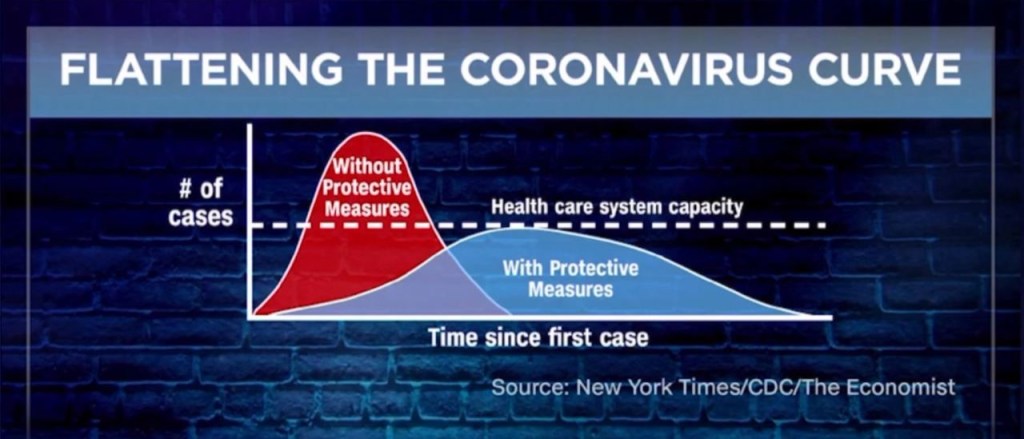
It feels like everyone is scrambling; everyone is sharing out resources for distance learning for teachers, Zoom is getting a ton of love these days, and parents are figuring out ways to home school their children. It’s pouring rain and we are being asked to practice social distancing measures to flatten the curve. Oh, and people are hoarding toilet paper.
It’s so easy to get sucked into the hysteria.
Our district decided that all work assigned during this school dismissal would be optional learning opportunities for students. I commend our district leadership for recognizing that equity and access might be an issue for many of our students and have made it clear that these assignments will not be used to determine grades.
With that being said, it makes it a big challenge for teachers to want to spend the time developing meaningful assignments and invest time with distance learning platforms when students know they are optional. For teachers, optional assignments mean that only a handful of students, at best, will engage with them.
I realized I had a couple of options when it came to creating these distance learning assignments. On one hand, I could just assign some review problems from their textbook and help students maintain skills; nothing wrong with this option. On the other hand I could do something to help students engage in new content; is that risky or worthwhile?
Well, I decided to do a little bit of both. Besides, if my students could learn a handful of new things on their own then maybe the 6 weeks won’t feel like such a loss in terms of instructional opportunities.
So, on the second day of our school dismissal I assigned new content for students to tinker with.
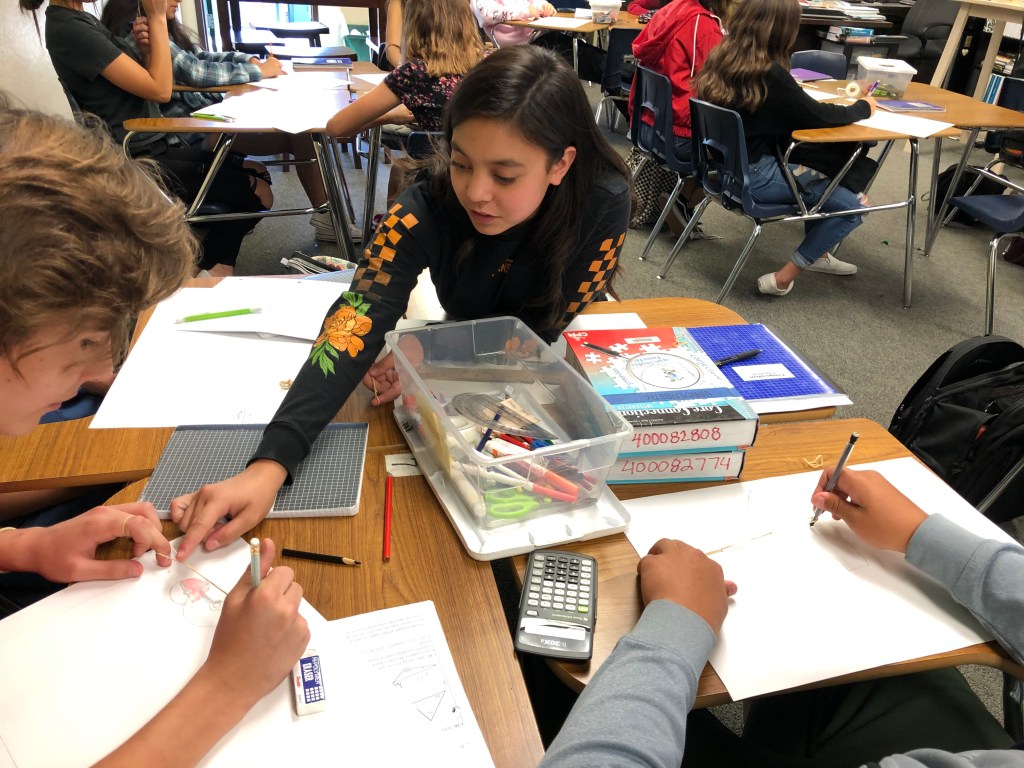
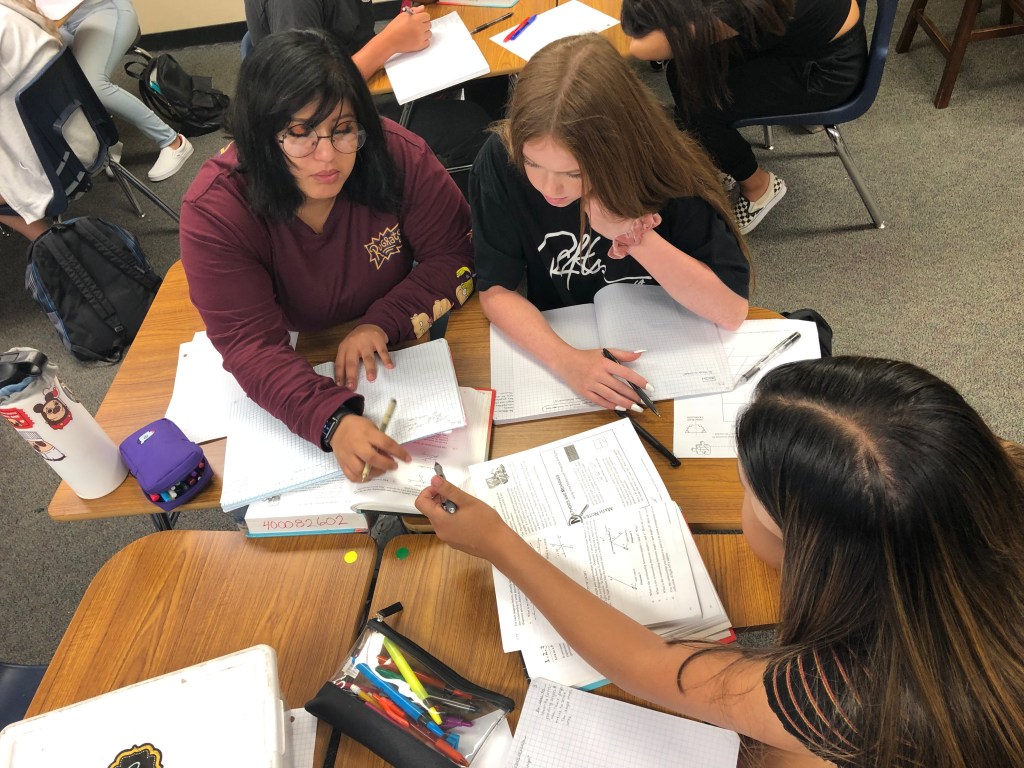
My classroom is not traditional and neither are my teaching methods. I ask my students to work collaboratively to learn math. I use guiding questions during an inquiry based lesson to lead my students to discover patterns and develop math algorithms for themselves. I rarely tell them how to do any math problem; I ask them how they think they should proceed and then give them a few suggestions or ideas so they can get started. I teach my students to take risks; that the faster they fail at a problem the sooner they’ll get to the answers they’re looking for. I’m there, answering questions, listening to their conversations, and nudging them in the right direction.
When I start a new lesson, I begin with the objective to help students focus on the goal for the day. Then my students, that work in teams of 4, begin the lesson by working through each problem together. Each student in the team has a role; for example, one is to read the problem out loud, one is to make sure everyone is writing down their work, another is responsible for making sure they work in a timely manner, and another makes sure they have all the resources they need to be successful.
Just as often as I am praised for teaching this way, I’m also criticized. I’ve been told that “I do, we do, you do” is good teaching. I’ve been given research on how Direct Instruction is still the best model because it’s tried and true; because students need direction otherwise they might do math wrong…especially in a situation like a school closure.
My hope is that I’ve prepared my students for this moment. This moment where my students are having to grapple with a [math] problem on their own and make sense of it without me just a few feet away from them. My hope is that my students dive in; that they see a math problem and just jump in to solve it.
My hope is that my students aren’t sitting in front of a computer screen, looking at that math problem, waiting for me to tell them exactly what to do.
My hope is that my students pulled out their notebooks, read through the problem and tried something, anything really, and tinkered with the math they already know in order to solve it…like they do, almost every day, in our math class.
My hope is that they reached out to their classmates, their friends, their parents, their anybody and tried to find solutions together; that they worked collaboratively with others to learn something new. My hope is that their text messages during this time included some math conversations because they wanted to figured out the solution because they felt confident enough to do so with just a little help from friends. My hope is that I can assign new content, that my students know how to access it, and that my students know that their best effort is enough.
My hope is that in my absence my students can do math.
This past weekend was the annual California Mathematics Council Southern Conference held in Palm Springs, CA. It’s one of my favorite weekends of the year. Brilliant educators from all over the country converge to share strategies and inspiration with one another. It’s an opportunity to connect with colleagues and discuss math – all the time.
This slideshow requires JavaScript.
One of the highlights of the weekend was a conversation I had with John Stevens. He’s the one at the end of the table, pictured in a chef’s coat (here’s why). He’s a Math and Technology Coach in Southern California, an author, a husband and father, and an Edu-hero and Math-lebrity in the math community (although he’ll tell you no to that). In short, he’s kind of a big deal.
Imagine my surprise when I discovered he would be joining us for lunch on Saturday afternoon. We have a mutual friend and I tried to contain my inner fan girl when we walked to the restaurant together.
John and I had an opportunity to connect as we waited for our friends to arrive for lunch. We started off with some small talk about how we were enjoying the conference and what we were going to order for lunch. He acknowledged that I had presented at the conference the day before and John’s next sentence began like this,
“Now that you [Patricia] have a seat at the table…”
…and I honestly don’t remember the end of this sentence because I think I blacked out a little…
I have a seat at the table? I…have a seat at THE TABLE?
You see, I’ve been a teacher for 14 years and I have attended this conference almost every year for the last 12 years but this was the first time that I was brave enough to be a speaker. I had the privilege of co-presenting a session with Matt Vaudrey (yes, theeeeeee Matt Vaudrey). It was an amazing experience and it was affirming to get some positive feedback from several teachers that stayed after to ask questions and say such nice things.
I shared with John that there’s a constant battle in my head when it comes to me sharing anything I’ve done in my classroom in a public forum. On one shoulder there’s a little guy telling me that what I’m doing is awesome and I should share it with others and on the other shoulder there’s a different little guy telling me, “this is old news, everyone knows [insert whatever cool thing I’m doing here] so don’t embarrass yourself by thinking you have something to contribute.”
John quickly stopped me, with a chuckle of disbelief at my statement, and reminded me that there is such a thing as “imposter syndrome,” and that I just needed to get over that because it’s holding me back. John helped me to realize that it’s not always about sharing something new; it’s also just as valuable for teachers to hear how we’ve taken something we’ve learned and made it our own.
Y’all, this guy is the real deal. He went on to share with me that he’s experienced times when he thought he had nothing else to share even after co-writing The Classroom Chef and writing Table Talk Math, the Would You Rather? site, and an extensive blog of really cool stuff. I can’t thank him enough for the very real, humble, and encouraging conversation. I really appreciated those few minutes with John and his affirmation that I have a seat at the table.
I should also note that Matt Vaudrey has pulled up a chair for me at the table on more than one occasion and I’m blessed because of it:
I’m glad I finally sat down.
I realized during this conference that there are so many talented teachers doing great things in their classrooms that make a big difference in the lives of their students. We need to hear from them too; their voices, their stories, their strategies so that we can all be better.
And yes, someone may have already said [insert whatever cool thing you’re doing here] before…but not in the way you’ll say it and not in the way you’ve done it and not at the time that you’ll share it with others.
I teach Integrated Math 2 classes that are specifically populated with students that have traditionally struggled in math and would benefit from a class environment that includes additional supports and opportunities for success.
I was approached by our department chair today and, because of the data, asked if this model was working. She hinted that our administration was considering dissolving these specific classes because students appear to not be successful. She told me to think about it but we needed to come up with a plan soon because the process for registering for next year’s classes would begin in a few weeks.
This isn’t working.
How is this being measured? By semester grades of course. The data looks bad; too many of our students are earning D’s and F’s on their semester report cards. I didn’t realize I was contributing to this trend until I sat down and looked at my own data.
I was recently in an IEP meeting for Ashley, a student of mine that has a learning disability. I described her as hard-working, open minded, and a good communicator. I shared with her parents that in our cooperative learning environment their daughter works well in teams and is a great self-advocate. Her parents were very surprised to hear that she is often the first one in her team to understand a concept and demonstrate mastery. She grasps concepts quickly and is able to articulate what she’s learned or what she needs help with.
But she’s getting a D in my class.
How can I describe this student as, basically, doing well in class when my records show she is earning a D?! She often demonstrates learning and sometimes even mastery of concepts in class. Where she struggles, as is the case with many of my students, is on the formal, written assessments…like, Chapter Tests. Oh, and by the way, Chapter Tests make up 80% of their grade.
Wait a minute…didn’t I just say that I teach classes that are specifically populated with students that have traditionally struggled in math and would benefit from a class environment that includes additional supports and opportunities for success?
This isn’t working. But, not because the model is wrong; it’s because I’ve failed at providing opportunities for my students to be successful.
I have spent most of my time setting high standards for my students because I didn’t want them to feel labeled or have any excuse for not putting in the effort to be successful. I wanted them to believe that they could do well in class, just like everybody else. I worried about my grading practices and wanted to make sure they aligned with my desire for student grades to reflect what they learned and not what they did. So, I grade on a rubric because I want to honor levels of mastery in my students. I thought this was enough but after looking at my data, I realize it’s not. I have not created enough opportunities for success.
This CAN work!
Here are some ways I plan to make some real changes in my classroom to honor my students’ learning:
Remember that assessments don’t always mean formal, written tests. If I’m looking for mastery of certain concepts, then I need to be flexible in the way I assess that. Maybe that means looking for students to do that in class while practicing. I envision myself walking around my classroom and observing student work; as I see a student successfully demonstrate mastery I check it off a list of goals I’ve created for the chapter.
Give students a choice on how they will be assessed. Loving the idea of Choose Your Own Assessment. Maybe students want to create a video, or a poster to demonstrate mastery. Maybe students want to just take a good old fashioned test. Either way, I want to give students the choice so that they can create something or do something they can be proud of.
Make assessments that are formal tests, but students get to choose the problems they complete. Definitely pulling my inspiration from The Classroom Chef on this one. It would be kind of like a menu of different courses to choose from. I envision a test with sections for each of the major concepts being tested. Within each section are three problems to choose from, each with increasing DOK level or difficulty level. Students get to pick 1, 2, or all 3 problems in each section to complete and they’ll only be graded on what they attempt.
Questions I have:
How important is it that students are able to pass a formal, written test?
Is demonstrating mastery in non-traditional, non- test-like ways as valid an assessment as a formal, written test?
Our school is moving towards common assessments. The rationale is that our students should all have the same skills by the end of the course. How important is it to participate in this?
What are some other ways to create opportunities for success?
My hope is for my students to have more success in math that’s not just reflected in their overall grades but in their attitudes about math. I am so grateful for this eye opening experience because it’s helped me to grow as a teacher to meet the needs of my students.
This CAN work. It’s going to work. I’m going to make it work.
This is the proverbial question students repeatedly ask their math teachers. I couldn’t tell you how often I have been asked this question. My answers have covered the entire spectrum of responses: thoughtful answers to the question that illicit meaningful discussion about math with my students to snarky, arrogant responses (coupled with eye rolling) that make students feel dumb for asking (sorry about that, guys).
I believe it’s this question that sparks the deep burning desire to make math meaningful and relate it to “real life” as often as possible.
This is a big task and in my experience throwing in the “real life” situations every now and then doesn’t come across as genuine as I would like. Not only are students already questioning when they will apply the math they’ve learned, they’re really not convinced when I give them a life example they can’t see themselves in (like standing at the top of a lighthouse curious about how far away a boat is).
I’m not saying it isn’t a great math problem tied to a real life situation…TRUST ME, I use this example regularly, and students calculate that distance using trigonometry with great success. However, after years of teaching math my burning desire isn’t just to relate math to real life but to give students the ability to THINK mathematically about the world they live in.
When I was an undergrad student at Cal Poly Pomona I had the most amazing professor, Dr. Greisy Winicki-Landman. She made me fall in LOVE with math; like, absolute love. Greisy made me think, taught me to defend my ideas, justify my conclusions, and made math “spicy.” Greisy introduced me to Math Trails during one of our math education classes at Cal Poly (here’s some helpful info on Math Trails). She took us on a field trip to Downtown Pomona and set us loose with measuring tapes, protractors, and stop-watches (we didn’t have smart phones then). We did math in the most unique places and great, literal, tangible way to apply the math we were learning.
So, I started creating my own Math Trails for my Geometry students. It was so awesome to see them walking around campus, measuring things and doing math to the world around them.
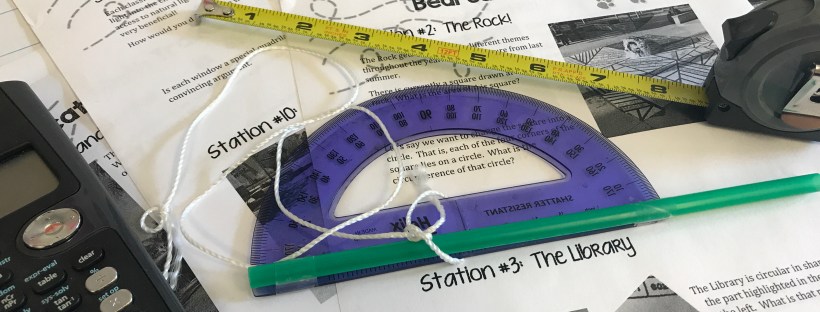
I sent students off with the Bearcat Math Trail, a list of stations with pictures, and a set of tools:
Measuring Tape
String and a drinking straw (for students to make a clinometer)
Protractor
Calculators
their cell phones
My students used measuring tapes to calculate how steep these support beams are. They also used the slope ratio with trigonometry to calculate the slope angle.
As they walked on campus they calculated the area of the painted square in the quad and the volume of an irregular shaped planter outside of a classroom. As they worked I checked in with them and asked questions like:
What are you measuring?
What do you need that distance for? How can you measure the angle?
What information do you need to answer the question?
How do you know that’s true?
All the while emphasizing many Mathematical Practices: make sense of problems & persevere in solving them, model with mathematics, use appropriate tools strategically, and attend to precision.
Some other stations included constructing a valid argument that the windows are rectangles by measuring the angles with a protractor and the lengths of the sides. Students were also asked to determine the average speed students walk as they exit the school along a pathway to the parking lot.
As I walked around and observed the students work I was so impressed with all the geometric concepts and relationships students used to solve the problems. Such great conversations and math discussions among students. I had one team lose their drinking straw and couldn’t make a clinometer. So, they decided to use their own height and shadow to create similar triangles to measure the height of a pole in the quad. So proud of that perseverance!
The best part: students come back later and tell me how they view the world differently and see math everywhere. Well, actually they say to me, “Thanks a lot, Mrs. V. I can’t look at anything without seeing some numbers or some shapes or something with math (insert eye rolling here).”
Of all the jobs I have ever had in my life my most favorite has been being a Boy Mama. I am blessed to be the mom of two amazing little boys, Robert and Travis. I never thought I would love them as much as I do because growing up I never really liked kids. I was not that woman that swooned over a baby or begged to hold one. In fact, when people I knew started having babies they had to practically force me to hold him/her…awkward. And I always hated when someone would ask, “Do you want to hold him (or her)?” I really, really wanted to say, “NOPE. I’m good, I can see the baby right here.”
Then I got pregnant. My husband and I went to our very first ultra sound appointment on our 10th wedding anniversary and we saw our baby for the first time. It was love at first sight. My heart grew so big and ached so much for this sweet little baby growing in my belly. It was a love like no other. Overwhelming, to say the least. I decided I loved this baby so much that I would do ANYTHING for him.
When Little Robert was 6 months old we discovered he was going to be a big brother. It was a busy season in our lives because my husband was preparing for his 3rd deployment with the Army to Afghanistan. He watched his second son, Travis, be born via FaceTime. And while it wasn’t ideal, I am so thankful that technology allowed us to share that moment together. More on this another time…
When we found out our family would be growing…it felt really too soon. I felt like I hadn’t had enough time with Little Robert and that with another baby on the way I would miss something. My attention would be divided and I wouldn’t be able to love them enough. I had just fallen so deeply in love with Little Robert…how could I ever love Baby Travis enough?
Thankfully, I have been blessed with amazing women in my life and my dear friends Deanna and Julie (former teachers of mine, turned co-workers, turned friends) told me, “Don’t worry, your heart just grows bigger.” And boy were they right. My heart swelled with joy and love for BOTH my sweet boys. I decided I loved these boys so much that I would do ANYTHING for them. These two boys are my greatest accomplishment. They are my best work.
Today, we took Little Robert on a tour of a preschool. It’s time for him to go to school so my husband and I are visiting schools to see which is the best fit for our family. As we were on our tour I asked discerning questions about curriculum, schedule, safety…but all the while I really just wanted to know if Little Robert’s teachers would take good care of him, be kind to him, discover how funny he is, see how creative he is, make him feel included and important, listen to him when he tells his imaginative stories…I just wanted to know if they would see just how special my boy is.
Little Robert will soon be a student in a classroom and before I know it he’ll be a high school student sitting in a classroom similar to mine. I don’t do it often enough, but sometimes I look out at my high school students and remember that they are children and they have a mom…or a dad…or a somebody…that loves them like I LOVE my boys. My students are someone’s greatest accomplishment.
When I remember this, I try a little harder…to be more prepared, to speak a little kinder, to have a little more patience, to be more encouraging, to be more engaging, to appreciate each student for who they are…because that student is someone’s baby.





















 Patricia Vandenberg