This isn’t working

I teach Integrated Math 2 classes that are specifically populated with students that have traditionally struggled in math and would benefit from a class environment that includes additional supports and opportunities for success.  

I was approached by our department chair today and, because of the data, asked if this model was working.  She hinted that our administration was considering dissolving these specific classes because students appear to not be successful.  She told me to think about it but we needed to come up with a plan soon because the process for registering for next year’s classes would begin in a few weeks.  

This isn’t working.

How is this being measured?  By semester grades of course.  The data looks bad;  too many of our students are earning D’s and F’s on their semester report cards.  I didn’t realize I was contributing to this trend until I sat down and looked at my own data.

Report-card-F

I was recently in an IEP meeting for Ashley, a student of mine that has a learning disability.  I described her as hard-working, open minded, and a good communicator.  I shared with her parents that in our cooperative learning environment their daughter works well in teams and is a great self-advocate.  Her parents were very surprised to hear that she is often the first one in her team to understand a concept and demonstrate mastery.  She grasps concepts quickly and is able to articulate what she’s learned or what she needs help with.  

But she’s getting a D in my class.

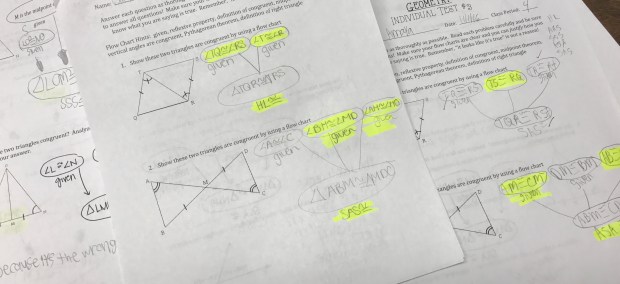
How can I describe this student as, basically, doing well in class when my records show she is earning a D?! She often demonstrates learning and sometimes even mastery of concepts in class.  Where she struggles, as is the case with many of my students, is on the formal, written assessments…like, Chapter Tests.  Oh, and by the way, Chapter Tests make up 80% of their grade.

giphy

Wait a minute…didn’t I just say that I teach classes that are specifically populated with students that have traditionally struggled in math and would benefit from a class environment that includes additional supports and opportunities for success?

This isn’t working.  But, not because the model is wrong;  it’s because I’ve failed at providing opportunities for my students to be successful.  

I have spent most of my time setting high standards for my students because I didn’t want them to feel labeled or have any excuse for not putting in the effort to be successful.  I wanted them to believe that they could do well in class, just like everybody else.  I worried about my grading practices and wanted to make sure they aligned with my desire for student grades to reflect what they learned and not what they did.  So, I grade on a rubric because I want to honor levels of mastery in my students.  I thought this was enough but after looking at my data, I realize it’s not.  I have not created enough opportunities for success.

This CAN work!

Here are some ways I plan to make some real changes in my classroom to honor my students’ learning:

  1. Remember that assessments don’t always mean formal, written tests.  If I’m looking for mastery of certain concepts, then I need to be flexible in the way I assess that.  Maybe that means looking for students to do that in class while practicing.  I envision myself walking around my classroom and observing student work;  as I see a student successfully demonstrate mastery I check it off a list of goals I’ve created for the chapter.
  2. Give students a choice on how they will be assessed.  Loving the idea of Choose Your Own Assessment.  Maybe students want to create a video, or a poster to demonstrate mastery.  Maybe students want to just take a good old fashioned test.  Either way, I want to give students the choice so that they can create something or do something they can be proud of.
  3. Make assessments that are formal tests, but students get to choose the problems they complete.  Definitely pulling my inspiration from The Classroom Chef on this one.  It would be kind of like a menu of different courses to choose from.  I envision a test with sections for each of the major concepts being tested.  Within each section are three problems to choose from, each with increasing DOK level or difficulty level.  Students get to pick 1, 2, or all 3 problems in each section to complete and they’ll only be graded on what they attempt.

Questions I have:

  1. How important is it that students are able to pass a formal, written test?
  2. Is demonstrating mastery in non-traditional, non- test-like ways as valid an assessment as a formal, written test?
  3. Our school is moving towards common assessments.  The rationale is that our students should all have the same skills by the end of the course.  How important is it to participate in this?
  4. What are some other ways to create opportunities for success?

My hope is for my students to have more success in math that’s not just reflected in their overall grades but in their attitudes about math.  I am so grateful for this eye opening experience because it’s helped me to grow as a teacher to meet the needs of my students.

This CAN work.  It’s going to work.  I’m going to make it work.

~PV~
Math Trails

“When are we ever going to use this?”

This is the proverbial question students repeatedly ask their math teachers.  I couldn’t tell you how often I have been asked this question.  My answers have covered the entire spectrum of responses:  thoughtful answers to the question that illicit meaningful discussion about math with my students to snarky, arrogant responses (coupled with eye rolling) that make students feel dumb for asking (sorry about that, guys).

BLOG math use

I believe it’s this question that sparks the deep burning desire to make math meaningful and relate it to “real life” as often as possible.  

This is a big task and in my experience throwing in the “real life” situations every now and then doesn’t come across as genuine as I would like.  Not only are students already questioning when they will apply the math they’ve learned, they’re really not convinced when I give them a life example they can’t see themselves in (like standing at the top of a lighthouse curious about how far away a boat is).  

BLOG math use 2

I’m not saying it isn’t a great math problem tied to a real life situation…TRUST ME, I use this example regularly, and students calculate that distance using trigonometry with great success.  However, after years of teaching math my burning desire isn’t just to relate math to real life but to give students the ability to THINK mathematically about the world they live in.

When I was an undergrad student at Cal Poly Pomona I had the most amazing professor, Dr. Greisy Winicki-Landman.  She made me fall in LOVE with math;  like, absolute love.  Greisy made me think, taught me to defend my ideas, justify my conclusions, and made math “spicy.”  Greisy introduced me to Math Trails during one of our math education classes at Cal Poly (here’s some helpful info on Math Trails).  She took us on a field trip to Downtown Pomona and set us loose with measuring tapes, protractors, and stop-watches (we didn’t have smart phones then).  We did math in the most unique places and great, literal, tangible way to apply the math we were learning.  

So, I started creating my own Math Trails for my Geometry students.  It was so awesome to see them walking around campus, measuring things and doing math to the world around them.

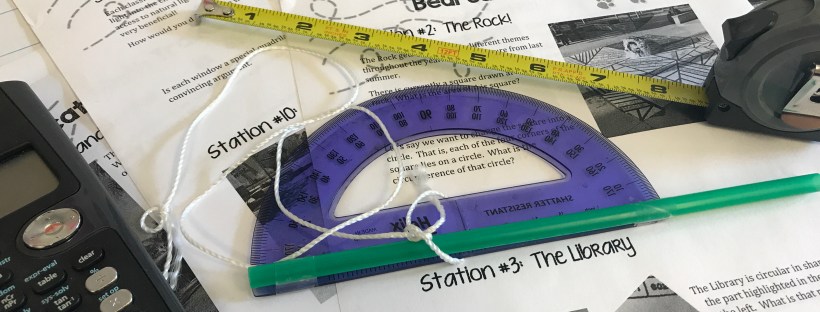
I sent students off with the Bearcat Math Trail, a list of stations with pictures, and a set of tools:

  • Measuring Tape
  • String and a drinking straw (for students to make a clinometer)
  • Protractor
  • Calculators
  • their cell phones

My students used measuring tapes to calculate how steep these support beams are.  They also used the slope ratio with trigonometry to calculate the slope angle.

As they walked on campus they calculated the area of the painted square in the quad and the volume of an irregular shaped planter outside of a classroom.  As they worked I checked in with them and asked questions like:

  • What are you measuring?
  • What do you need that distance for?  How can you measure the angle?
  • What information do you need to answer the question?
  • How do you know that’s true?

All the while emphasizing many Mathematical Practices:  make sense of problems & persevere in solving them, model with mathematics, use appropriate tools strategically, and attend to precision.

Some other stations included constructing a valid argument that the windows are rectangles by measuring the angles with a protractor and the lengths of the sides.  Students were also asked to determine the average speed students walk as they exit the school along a pathway to the parking lot.

As I walked around and observed the students work I was so impressed with all the geometric concepts and relationships students used to solve the problems.  Such great conversations and math discussions among students.  I had one team lose their drinking straw and couldn’t make a clinometer.  So, they decided to use their own height and shadow to create similar triangles to measure the height of a pole in the quad.  So proud of that perseverance!

The best part:  students come back later and tell me how they view the world differently and see math everywhere.  Well, actually they say to me, “Thanks a lot, Mrs. V.  I can’t look at anything without seeing some numbers or some shapes or something with math (insert eye rolling here).”  

Mission accomplished.

~PV~

An Open Letter to my Seniors

Statistical Reasoning in Sports;  my first thoughts were, “Um….I’m not a sports person (like, at all) and statistics is my least favorite of all the maths (because I was not great at it).”

Perfect.

After the initial shock, I realized that teaching Sports Stats (as we called it) was just another challenge for me to overcome.  I knew it would make me a better teacher, it would strengthen my math skills, and I would probably learn some sports along the way. And let’s be honest, I finally landed my dream job, at my dream school so I wasn’t going to say no.

Challenge accepted.  I knew the Stats.  You knew the sports.  I prayed we’d help each other get through the year.

Blog Pic_Seniors

As the year went on we did just that;  I taught you some stats and you answered my endless questions about sports.  We learned about the “hot hand”, hypotheses testing, winning streaks and losing streaks.  We rejected things;  we failed to reject things (whatever that meant?!).  We even did a March Madness bracket based on statistical concepts we learned.  All along the way you taught me bits and pieces of sports based on your experiences playing and watching games.  We always had someone in the room that knew about swim, or football, or softball, or golf;  so someone always patiently answered my questions.

Here we are at the end of the school year; the end of your fourth year at our school.  You have all worked so hard for this moment which is evident in the list of impressive college acceptances and even more inspiring future goals.  And even though we’ve spent an entire school year together, the time has just slipped by and now here we are at the end.

FASTBALL_FEATUREIMAGE-640x320-1

We watched the baseball documentary, Fastball.  I was moved.  I had no idea how elegant the game of baseball is;  the dance between a pitcher and a hitter (the guy with the bat is called a hitter, right?) requires so much skill, finesse, and of course math.  This was the moment.

Suddenly, I was very aware of all the baseball players in our class and what positions they play and all of a sudden now I know that the pitcher is a big deal, and the catcher is a big deal, and all of a sudden I knew that everyone that has  to hit that baseball with a bat is a BIG. DEAL.

All the bits and pieces of sports you have been sharing with me started flooding into my mind.  

Then I started to wonder about all of you, and the sport you humbly said you played.  You don’t just play football, you’re the captain, aren’t you?  You’re not just on the basketball team, you brought our team to the CIF Championships, right?  You don’t just play volleyball, you’re playing in college on a scholarship because you’re that good, huh? Wait, I saw you at the signing ceremony in the gym because you are a star softball player. Then I started to wonder more…that wasn’t just some random pair of shoes you were painting, or dance you were performing, or song you were singing, was it?  Hold on, that’s YOUR painting on display in the Art Show?  That was YOU up on stage at the Pop Show?  

That was the moment it all clicked for me. It just clicked. I didn’t get a chance to know you.  I didn’t get a chance to really get to know how amazing you are.  All of that is just starting to unfold for me and I’ve only got a couple more minutes with you before you go off into the world and do amazing things.  For the first time I am starting to see you clearly.  You are the captains of Varsity teams.  You are the starting player at each of your games.  You are athletes.  You are award winning artists, musicians, singers, dancers, philanthropists, entrepreneurs, and leaders.  I am so blessed to have taught you.  What a privilege it has been to be your teacher! I know, for a fact, that you taught me far more than I taught you this year.  And for that, I’ll always be grateful and I’ll never forget any of you.

I don’t want you to leave yet, but I know you must.

Your last year here was my first year and I finally feel like I have my bearings;  I can finally stop and take a look around.  And I know I don’t know some of you at all.  We didn’t spend a lot of time together.  I didn’t find the time to get to know you.  I just want you to know that I see you just as clearly as I do anyone else in our class.  And I wish I had more time with you.

Be brave.  Do amazing things, even if they scare you (like teaching Statistical Reasoning in Sports scared me!).  You’ll learn and grow from each of those experiences in the most rewarding ways.  

Thank you for a great year,

Mrs. Vandenberg

That Student is Someone’s Baby

Of all the jobs I have ever had in my life my most favorite has been being a Boy Mama.  I am blessed to be the mom of two amazing little boys, Robert and Travis.  I never thought I would love them as much as I do because growing up I never really liked kids.  I was not that woman that swooned over a baby or begged to hold one.  In fact, when people I knew started having babies they had to practically force me to hold him/her…awkward.  And I always hated when someone would ask, “Do you want to hold him (or her)?” I really, really wanted to say, “NOPE.  I’m good, I can see the baby right here.”

Then I got pregnant.  My husband and I went to our very first ultra sound appointment on our 10th wedding anniversary and we saw our baby for the first time.  It was love at first sight.  My heart grew so big and ached so much for this sweet little baby growing in my belly.  It was a love like no other.  Overwhelming, to say the least.  I decided I loved this baby so much that I would do ANYTHING for him.

img_0037

When Little Robert was 6 months old we discovered he was going to be a big brother.  It was a busy season in our lives because my husband was preparing for his 3rd deployment with the Army to Afghanistan.  He watched his second son, Travis, be born via FaceTime.  And while it wasn’t ideal, I am so thankful that technology allowed us to share that moment together.  More on this another time…

When we found out our family would be growing…it felt really too soon.  I felt like I hadn’t had enough time with Little Robert and that with another baby on the way I would miss something.  My attention would be divided and I wouldn’t be able to love them enough.  I had just fallen so deeply in love with Little Robert…how could I ever love Baby Travis enough?

Thankfully, I have been blessed with amazing women in my life and my dear friends Deanna and Julie (former teachers of mine, turned co-workers, turned friends) told me, “Don’t worry, your heart just grows bigger.”  And boy were they right.  My heart swelled with joy and love for BOTH my sweet boys.  I decided I loved these boys so much that I would do ANYTHING for them.  These two boys are my greatest accomplishment.  They are my best work.

img_0122

Today, we took Little Robert on a tour of a preschool.  It’s time for him to go to school so my husband and I are visiting schools to see which is the best fit for our family.  As we were on our tour I asked discerning questions about curriculum, schedule, safety…but all the while I really just wanted to know if Little Robert’s teachers would take good care of him, be kind to him, discover how funny he is, see how creative he is, make him feel included and important, listen to him when he tells his imaginative stories…I just wanted to know if they would see just how special my boy is.

Processed with VSCO with a6 preset

Little Robert will soon be a student in a classroom and before I know it he’ll be a high school student sitting in a classroom similar to mine.  I don’t do it often enough, but sometimes I look out at my high school students and remember that they are children and they have a mom…or a dad…or a somebody…that loves them like I LOVE my boys.  My students are someone’s greatest accomplishment.

When I remember this, I try a little harder…to be more prepared, to speak a little kinder, to have a little more patience, to be more encouraging, to be more engaging, to appreciate each student for who they are…because that student is someone’s baby.

~PV~

What if tests were just easier?

The wheels were turning after a brief conversation with Matt Vaudrey.

What if tests were just easier?

What if we just made tests easier?  What if on test day they walked in peaceful, knowing it wasn’t going to be that bad?  What if they went home feeling more confident about math because of the test?  What if students left class, after a test, feeling awesome?

blog-pic_testing

What if this was a happy day instead of the dreaded test day?

Does it have to be bad?  Does it have to be hard?  What if tests were more straight forward, clear, direct?  What if I saved the complex, interesting, real world problems that synthesized information for in-class activities instead of tests?  What if we did all that cool stuff  together?  Where more meaningful discussions could happen?  Where opportunities for students to learn collaboratively was possible?  Where I could monitor student progress more closely, in real time?

What if testing them meant something different?  What if we changed the intent of the test?  What if testing didn’t mean giving them a set of problems to complete just to spend hours grading, for it to only give me assessment data that I already know?  What if tests weren’t only used as indicators of what students know and what they don’t know?  What if we used math tests differently?  What if we used tests for a different purpose?  What if math tests had additional purpose?  Do you know your test’s purpose?  Does your test have a purpose?

blog-pic_testing-2

Maybe learning stops when a test score is issued?  What if tests didn’t have grades?  What if we just highlighted mistakes to fix?  Maybe learning would continue?  (Stay tuned, I just did this…I’ll blog about the results soon!)

What if tests were used to build math confidence instead of beating that confidence down?  What if tests were used to positively reinforce being brave, taking risks, and flexing those problem solving skills we so desperately try to develop in them?  What if we used other forms of assessments to test knowledge in addition to tests?  What if we used other assessments INSTEAD of tests?

What if we stopped testing students to see if they take that amazing problem, make the right connections on a paper/pencil test that we grade right/wrong and then give them points, update the grade online, give the test back, and then MOVE ON to the next chapter NEVER to talk to them about how freaking awesome that problem was?!  I mean…

What if?

Maybe my students would feel more confident about their math skills?  Maybe my students would focus on learning and not on point gathering?  Maybe my students would feel empowered in a math classroom instead of discouraged?  Maybe it would change their attitudes about math?  Maybe their parents’ attitudes would change too?  Maybe they would all stop saying, “I’m just not a math person”?  Maybe they would all stop forgiving themselves for not being good at math and start trying to be good at math?  Maybe my students would enjoy math more?

Maybe my students would take more risks?  Maybe the increased confidence will make them brave when given a problem they’ve never seen before?  Maybe it would make them fearless mathematicians?!  Ooooohhhhh, FEARLESS MATHEMATICIANS!  Maybe it would make them better problem solvers?  Maybe their performance would be stronger because they would be more willing to perform?  And maybe, just maybe, we’d see that translate into something measurable, in something valued by education…like standardized test scores?

Maybe it’s worth a shot to just make the test easier?

Dear “…stuffed-shirt, overpaid, abstracted Educator…”

Last weekend was the California Mathematics Council’s southern conference, CMC South, held in Palm Springs.  I love this conference.  I always leave the conference on a super math high.  It is just the energy boost I need to get me through November and December and it leaves me with enough inspiration to make big changes in January.  It’s like they planned it that way…or something.

I have been teaching for just over a decade and I have attended CMC South every year.  Even when it wasn’t in the school budget I would find it in my personal budget to go.  I started my teaching career in a small, all-girls Catholic high school and found I did not have many people to collaborate with on best practices so I came to this conference hungry for information and inspiration.  In my early years I came to get “stuff”:  lesson plans, handouts, worksheets, already made items or detailed instructions on something I could do on Monday.  Now I come for inspiration.  I come to be reminded why I am in this profession, motivation to continue teaching math in spectacular ways, and for affirmation that what I am doing is meaningful and worthwhile.

CMC South did not disappoint this year.  I have never felt more energized and inspired to be a math teacher.  In fact, this CMC was different and probably the most memorable for me in all my years of attendance.  I was selfish with my time;  I only attended the sessions that truly served me and I took time to unpack things I heard and reflected on things I wrote down.  I had great company with me;  fellow math teachers, administrators, math coaches, and mathlebrities that were more than happy to discuss math education all day long.  And I had the opportunity to break bread with some incredible people in math education…I mean, when Robert Kasplinsky invites you to a dinner with #MTBoS peeps and you’re rubbing elbows with The Classroom ChefsNanette Johnson, and Dan Meyers it really makes you feel like you’re in the right place doing the right thing, am I right?!

cmc-math-2016

#MTBoS Dinner at CMC South.  Photo cred:  Meeeeeeeeeee!  Because I was there…NBD.


Now, I know this is not the experience everyone had at CMC.  This is not the experience I’ve had at every CMC.  Conversations during and after this conference with colleagues and friends confirmed this;  some have even said they wouldn’t come back because there’s just not value in the ideal picture that many of the presenters share.  The theory of math education just doesn’t translate well in a practical classroom (to put it nicely).  Some teachers walk away from these conferences with so little while my cup is overflowing.  Every experience is different, and that’s okay, but these conversations humbled me and made me wonder if I was really learning something from these conferences or if it was all just “fluff.”  Was my head was way to high up in the math clouds?  Was I going to come crashing down come Monday morning?

Then, I came across Matt Vaudrey’s blog.

He writes:

It’s easy to dream about big ideas, but some of the daily stuff is kicking my ass.

And worse than that; I’m feeling like the stuffed-shirt, overpaid, abstracted Educator that presents at conferences about ideas s/he hasn’t tried.

I’ve sat in those sessions and rolled my eyes and murmured to my teammate, “Aw, he’s a consultant.”

What can s/he possibly know about real teaching?

I am grateful for the experience I had at CMC.  I had the pleasure of attending Matt’s session at CMC and experienced a shift in my perspective about classroom culture.  It was very inspiring.  I can appreciate Matt’s vulnerability and humility in his post and I wondered if many consultants and math coaches feel this way often.  Especially the ones I’ve grown to respect and admire.

So, I wanted to write back to all the really good educational coaches and consultants out there:

Dear “…stuffed-shirt, overpaid, abstracted Educator…”,

You breathe new life into me every time I listen to you speak.  I need you to dream because I don’t always have time to dream.  If you don’t dabble in educational theory and share your discoveries with me, who will?  We need you to keep doing what you’re doing; because you’re good at it and you influence our classrooms in positive ways.

You’re what picks me up off the floor on the really tough days of teaching when everything feels like it’s going wrong.  You are who sets my gaze towards the prize of making a difference in my students’ lives.  You remind me why I got in this profession, renew my passion for teaching, and help me be the best for my students.  The ideals that you model are what helps me set goals for my own career and for my students.  I know I’m not going to reach those goals on the Monday after the conference but you motivate me to work towards them.

In short, thank you.  You make me think.  You make me wonder.  You make me great.  You make all of us great.

Success in a Math Classroom

I had my first formal observation today with my new principal.  Yesterday, I met with him and had my “pre-observation” meeting.  My principal asked me, “is there anything you want me to look out for tomorrow?”  And I responded with, “Well, I suck at first period.”  He laughed and told me this was normal;  assured me that it was because my students and me were still trying to get our rhythm that early in the day and it was understandable it wasn’t my best class.

blog-post_1

So, the perfectionist that I am, I stayed up late perfecting my lesson (not in a way that was different from my normal, but let’s be honest…best foot forward for this lesson, right?!)  I was excited and ready.  I made tons of notes of all the brilliant things I was going to do in class.  It was going to be great.  Here we go!

blog-post_2

The bell rings and I’m outside my door greeting my students.  They are getting new seats in their new teams so I had to hand them a random card that tells them where they sit in class.  Of course 40% of my students were super late so it made the start of class a little rough.  Then, my lesson did NOT go as planned (surprise, surprise…ugh!).  I had a student that was super off task that I had to prompt several times during the lesson.  Really?!  That kid could NOT figure out that Mr. Principal was in the room and act appropriately?!  Then, what was supposed to take only 15 minutes, the intro or warm-up to the lesson, took almost the whole class period.  This meant the amazing closure activity I had planned would not be relevant or meaningful to them!  I was bummed and very paranoid that I had not shown my principal “enough” of a lesson to evaluate me.

Second period bell rings.  It’s my prep so my principal sticks around a little to chat.  He said, “You’ve got to celebrate your successes!”

It was a great conversation;  positive and affirming in all the right ways.  He reminded me that success in my classroom means the student that got up in front of the class and explained perfectly how to use Pythagorean Theorem to the class;  success in my classroom means the argument he overheard two students having about the difference between intersecting and perpendicular lines;  success in my classroom means the girl that articulated so eloquently to the class how she figured out the slope of a segment.  And yeah, I didn’t get through the whole lesson but all of THAT happened in 1 class period.

He also reminded me that I teach the low-performing students.  My classes are primarily loaded with students that have traditionally struggled in math so they walk in the door already hating Geometry because it’s a math class.  He reminded me there are a slew of “intentional non-learners” that I am working with.  So, those students that stood up in front of their peers and spoke so beautifully about math are the ones who would have never done that before taking my class.  Those students would have never had arguments about math concepts before taking my class.  My class.  MY class.  I did that.  I facilitated that.  That is success in MY classroom.  It may not be pretty (like students that jump for joy at the idea of writing a proof!) but as they say, “beauty is in the eye of the beholder.”

This was a huge lesson that I needed to learn today because I feel like I fail as a teacher on the daily.  I know I’m my own worse critic and that failures can drive us to be better, but sometimes you just need an affirmation!  Maybe it’s because my definition of success and failure does not fit for my classroom.  In fact, success looks different in every teacher’s classroom.  What seemed so small to me, like a student getting up in front of the class and explaining something, was really a momentous occasion to be celebrated.

As educators, we have to find these successes, celebrate them, and then make them happen again and again.