
Last weekend I attended the CPM Teacher Conference in San Francisco, CA. It was a fantastic experience to not only be there but to also present a workshop and speak at the Ignite session–but more on that later.
One highlight of the weekend was attending Chris Luzniak‘s session on Debate Math. In his presentation, Chris describes that an argument consists of 2 answers: a claim and a warrant. Then, when asking a mathematical question, Chris instructs his students to use this sentence frame to state their argument:
“My claim is __________________,
and my warrant is _________________.”
He began the session with some fun, non-math questions that we debated:
- What’s the best TV show?
My argument: My claim is Friends is the best TV show, and my warrant is that the writing is very witty and the actors play their parts so well.
- The most important thing I want my students to learn is ___?
My argument: My claim is that I want my students to learn that every one of them can do math, and my warrant is that hard work pays off.
Then Chris began asking us math related questions and continued to have us debate using the same routine of argument = claim + warrant. As I listened to people’s arguments, I tried to imagine what it would look like to implement this in my classroom with my students. Then, Chris puts up this slide:
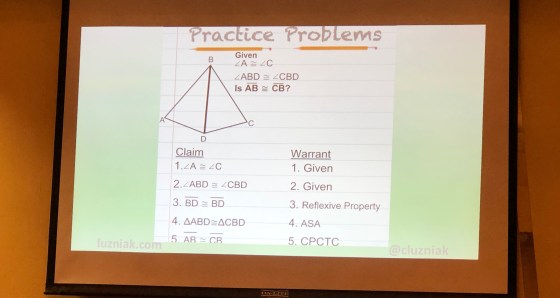
I was sold! I thought about how many times I had tried to get my students to understand how to write 2-column proofs in Geometry with no real success and unfortunately, most teachers I’ve collaborated with regarding this topic haven’t had anything as exciting as this. And I couldn’t have asked for better timing as my lesson plans for the following week included flow chart proofs on congruent triangles in Integrated Math 1 and 2-column proofs of properties of quadrilaterals in Integrated Math 2.
I got home from the conference and got to work right away!
Day 1: The Monday after the conference we happened to have a minimum day so it was the perfect amount of time to introduce the debate structure to my students. I used this slide deck in Integrated Math 2 and had them practice using the sentence frame with non-math topics and then a few easy math questions. I followed Chris’ debate structure including asking students to stand while making their argument.
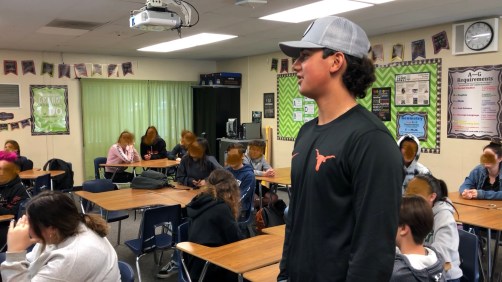
The most surprising thing was that the students that typically don’t participate or engage much were the ones debating the most! I had students that never want to take notes or do any math during class *jumping* out of their seats to make an argument.
Day 2: In Integrated Math 1 we began a unit on congruent triangles. We had really only done the first lesson where my students learned that 2 figures are congruent if (1) there is a series of rigid transformations that maps one object onto the other and (2) all the corresponding angle and side measures are congruent. So, I began the next lesson with this slide deck (remember that I had already spent the day before going over the structure and sentence frame).
The question was “Are the shapes congruent?” and my students, just on day 2, already knew to stand up and use the sentence frame, “My claim is…, and my warrant is…” All the slides led to the reinforcement that all corresponding angle and side measures must be equal for the shapes to be congruent. The last slide in the deck was this one:
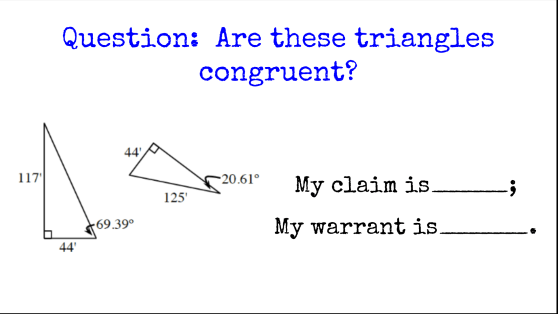
For this one, students needed to calculate missing angle measures using the Triangle Angle Sum Theorem and calculate the missing side lengths with Pythagorean Theorem. As they found missing measurements, my students stood and clearly argued how they found each missing angle measure and side length:
“My claim is the missing angle is 20.61 degrees, my warrant is the sum of the 3 angles is 180 so if I add 69.39 and 90 together, then subtract from 180 I get the missing angle [measure].”
“My claim is the missing side length is 125 feet, my warrant is when I use Pythagorean Theorem, 44 squared plus 117 squared equals c squared…then I take the square root and get 125 feet.”
This was a great way to open the lesson and get them primed for the triangle congruence conditions. They had already argued clearly what it meant for triangles to be congruent and they were ready to discover the shortcuts to determining triangle congruence (SSS, SAS, ASA, AAS, and HL).
One of the Standards of Mathematical Practice tell us that students should be able to construct viable arguments and critique the reasoning of others (SMP3). The structure of Debate Math helps students do just that!
As I listened to my students make their arguments, I realized even more reasons why I love Debate Math:
- Having to say their idea around the words “claim” and “warrant” made them instantly elevate their vocabulary and use of academic language.
- Students making their argument spoke slowly, clearly, and with authority.
- Students were listening, not just respectfully, but intently to each other; making sure they used the sentence frame properly and checking that their warrants were solid and valid.
And things just keep getting better: Days 3 and 4 we were writing flow chart proofs and the words claim and warrant felt more organic to the process than teaching them to use the traditional language of “statements” and “reasons”.
Needless to say I’m so excited to get to 2-column proofs! Wow, did I really just say that?!
~PV~
 Patricia Vandenberg