“When are we ever going to use this?”
This is the proverbial question students repeatedly ask their math teachers. I couldn’t tell you how often I have been asked this question. My answers have covered the entire spectrum of responses: thoughtful answers to the question that illicit meaningful discussion about math with my students to snarky, arrogant responses (coupled with eye rolling) that make students feel dumb for asking (sorry about that, guys).

I believe it’s this question that sparks the deep burning desire to make math meaningful and relate it to “real life” as often as possible.
This is a big task and in my experience throwing in the “real life” situations every now and then doesn’t come across as genuine as I would like. Not only are students already questioning when they will apply the math they’ve learned, they’re really not convinced when I give them a life example they can’t see themselves in (like standing at the top of a lighthouse curious about how far away a boat is).

I’m not saying it isn’t a great math problem tied to a real life situation…TRUST ME, I use this example regularly, and students calculate that distance using trigonometry with great success. However, after years of teaching math my burning desire isn’t just to relate math to real life but to give students the ability to THINK mathematically about the world they live in.
When I was an undergrad student at Cal Poly Pomona I had the most amazing professor, Dr. Greisy Winicki-Landman. She made me fall in LOVE with math; like, absolute love. Greisy made me think, taught me to defend my ideas, justify my conclusions, and made math “spicy.” Greisy introduced me to Math Trails during one of our math education classes at Cal Poly (here’s some helpful info on Math Trails). She took us on a field trip to Downtown Pomona and set us loose with measuring tapes, protractors, and stop-watches (we didn’t have smart phones then). We did math in the most unique places and great, literal, tangible way to apply the math we were learning.
So, I started creating my own Math Trails for my Geometry students. It was so awesome to see them walking around campus, measuring things and doing math to the world around them.
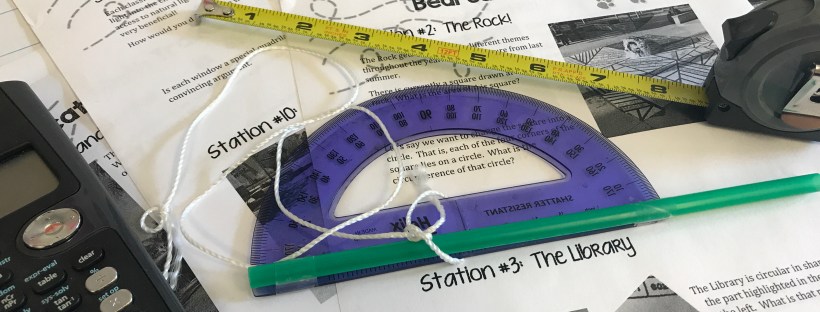
I sent students off with the Bearcat Math Trail, a list of stations with pictures, and a set of tools:
- Measuring Tape
- String and a drinking straw (for students to make a clinometer)
- Protractor
- Calculators
- their cell phones


My students used measuring tapes to calculate how steep these support beams are. They also used the slope ratio with trigonometry to calculate the slope angle.


As they walked on campus they calculated the area of the painted square in the quad and the volume of an irregular shaped planter outside of a classroom. As they worked I checked in with them and asked questions like:
- What are you measuring?
- What do you need that distance for? How can you measure the angle?
- What information do you need to answer the question?
- How do you know that’s true?
All the while emphasizing many Mathematical Practices: make sense of problems & persevere in solving them, model with mathematics, use appropriate tools strategically, and attend to precision.


Some other stations included constructing a valid argument that the windows are rectangles by measuring the angles with a protractor and the lengths of the sides. Students were also asked to determine the average speed students walk as they exit the school along a pathway to the parking lot.
As I walked around and observed the students work I was so impressed with all the geometric concepts and relationships students used to solve the problems. Such great conversations and math discussions among students. I had one team lose their drinking straw and couldn’t make a clinometer. So, they decided to use their own height and shadow to create similar triangles to measure the height of a pole in the quad. So proud of that perseverance!
The best part: students come back later and tell me how they view the world differently and see math everywhere. Well, actually they say to me, “Thanks a lot, Mrs. V. I can’t look at anything without seeing some numbers or some shapes or something with math (insert eye rolling here).”
Mission accomplished.
~PV~
 Patricia Vandenberg