What if tests were just easier?

The wheels were turning after a brief conversation with Matt Vaudrey.

What if tests were just easier?

What if we just made tests easier?  What if on test day they walked in peaceful, knowing it wasn’t going to be that bad?  What if they went home feeling more confident about math because of the test?  What if students left class, after a test, feeling awesome?

blog-pic_testing

What if this was a happy day instead of the dreaded test day?

Does it have to be bad?  Does it have to be hard?  What if tests were more straight forward, clear, direct?  What if I saved the complex, interesting, real world problems that synthesized information for in-class activities instead of tests?  What if we did all that cool stuff  together?  Where more meaningful discussions could happen?  Where opportunities for students to learn collaboratively was possible?  Where I could monitor student progress more closely, in real time?

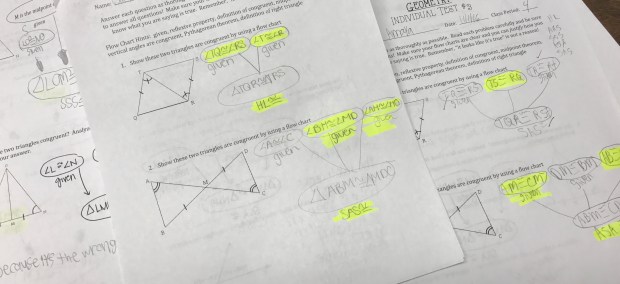
What if testing them meant something different?  What if we changed the intent of the test?  What if testing didn’t mean giving them a set of problems to complete just to spend hours grading, for it to only give me assessment data that I already know?  What if tests weren’t only used as indicators of what students know and what they don’t know?  What if we used math tests differently?  What if we used tests for a different purpose?  What if math tests had additional purpose?  Do you know your test’s purpose?  Does your test have a purpose?
blog-pic_testing-2

Maybe learning stops when a test score is issued?  What if tests didn’t have grades?  What if we just highlighted mistakes to fix?  Maybe learning would continue?  (Stay tuned, I just did this…I’ll blog about the results soon!)

What if tests were used to build math confidence instead of beating that confidence down?  What if tests were used to positively reinforce being brave, taking risks, and flexing those problem solving skills we so desperately try to develop in them?  What if we used other forms of assessments to test knowledge in addition to tests?  What if we used other assessments INSTEAD of tests?

What if we stopped testing students to see if they take that amazing problem, make the right connections on a paper/pencil test that we grade right/wrong and then give them points, update the grade online, give the test back, and then MOVE ON to the next chapter NEVER to talk to them about how freaking awesome that problem was?!  I mean…

What if?

Maybe my students would feel more confident about their math skills?  Maybe my students would focus on learning and not on point gathering?  Maybe my students would feel empowered in a math classroom instead of discouraged?  Maybe it would change their attitudes about math?  Maybe their parents’ attitudes would change too?  Maybe they would all stop saying, “I’m just not a math person”?  Maybe they would all stop forgiving themselves for not being good at math and start trying to be good at math?  Maybe my students would enjoy math more?

Maybe my students would take more risks?  Maybe the increased confidence will make them brave when given a problem they’ve never seen before?  Maybe it would make them fearless mathematicians?!  Ooooohhhhh, FEARLESS MATHEMATICIANS!  Maybe it would make them better problem solvers?  Maybe their performance would be stronger because they would be more willing to perform?  And maybe, just maybe, we’d see that translate into something measurable, in something valued by education…like standardized test scores?

Maybe it’s worth a shot to just make the test easier?

Dear “…stuffed-shirt, overpaid, abstracted Educator…”

Last weekend was the California Mathematics Council’s southern conference, CMC South, held in Palm Springs.  I love this conference.  I always leave the conference on a super math high.  It is just the energy boost I need to get me through November and December and it leaves me with enough inspiration to make big changes in January.  It’s like they planned it that way…or something.

I have been teaching for just over a decade and I have attended CMC South every year.  Even when it wasn’t in the school budget I would find it in my personal budget to go.  I started my teaching career in a small, all-girls Catholic high school and found I did not have many people to collaborate with on best practices so I came to this conference hungry for information and inspiration.  In my early years I came to get “stuff”:  lesson plans, handouts, worksheets, already made items or detailed instructions on something I could do on Monday.  Now I come for inspiration.  I come to be reminded why I am in this profession, motivation to continue teaching math in spectacular ways, and for affirmation that what I am doing is meaningful and worthwhile.

CMC South did not disappoint this year.  I have never felt more energized and inspired to be a math teacher.  In fact, this CMC was different and probably the most memorable for me in all my years of attendance.  I was selfish with my time;  I only attended the sessions that truly served me and I took time to unpack things I heard and reflected on things I wrote down.  I had great company with me;  fellow math teachers, administrators, math coaches, and mathlebrities that were more than happy to discuss math education all day long.  And I had the opportunity to break bread with some incredible people in math education…I mean, when Robert Kasplinsky invites you to a dinner with #MTBoS peeps and you’re rubbing elbows with The Classroom ChefsNanette Johnson, and Dan Meyers it really makes you feel like you’re in the right place doing the right thing, am I right?!

cmc-math-2016

#MTBoS Dinner at CMC South.  Photo cred:  Meeeeeeeeeee!  Because I was there…NBD.


Now, I know this is not the experience everyone had at CMC.  This is not the experience I’ve had at every CMC.  Conversations during and after this conference with colleagues and friends confirmed this;  some have even said they wouldn’t come back because there’s just not value in the ideal picture that many of the presenters share.  The theory of math education just doesn’t translate well in a practical classroom (to put it nicely).  Some teachers walk away from these conferences with so little while my cup is overflowing.  Every experience is different, and that’s okay, but these conversations humbled me and made me wonder if I was really learning something from these conferences or if it was all just “fluff.”  Was my head was way to high up in the math clouds?  Was I going to come crashing down come Monday morning?

Then, I came across Matt Vaudrey’s blog.

He writes:

It’s easy to dream about big ideas, but some of the daily stuff is kicking my ass.

And worse than that; I’m feeling like the stuffed-shirt, overpaid, abstracted Educator that presents at conferences about ideas s/he hasn’t tried.

I’ve sat in those sessions and rolled my eyes and murmured to my teammate, “Aw, he’s a consultant.”

What can s/he possibly know about real teaching?

I am grateful for the experience I had at CMC.  I had the pleasure of attending Matt’s session at CMC and experienced a shift in my perspective about classroom culture.  It was very inspiring.  I can appreciate Matt’s vulnerability and humility in his post and I wondered if many consultants and math coaches feel this way often.  Especially the ones I’ve grown to respect and admire.

So, I wanted to write back to all the really good educational coaches and consultants out there:

Dear “…stuffed-shirt, overpaid, abstracted Educator…”,

You breathe new life into me every time I listen to you speak.  I need you to dream because I don’t always have time to dream.  If you don’t dabble in educational theory and share your discoveries with me, who will?  We need you to keep doing what you’re doing; because you’re good at it and you influence our classrooms in positive ways.

You’re what picks me up off the floor on the really tough days of teaching when everything feels like it’s going wrong.  You are who sets my gaze towards the prize of making a difference in my students’ lives.  You remind me why I got in this profession, renew my passion for teaching, and help me be the best for my students.  The ideals that you model are what helps me set goals for my own career and for my students.  I know I’m not going to reach those goals on the Monday after the conference but you motivate me to work towards them.

In short, thank you.  You make me think.  You make me wonder.  You make me great.  You make all of us great.

Success in a Math Classroom

I had my first formal observation today with my new principal.  Yesterday, I met with him and had my “pre-observation” meeting.  My principal asked me, “is there anything you want me to look out for tomorrow?”  And I responded with, “Well, I suck at first period.”  He laughed and told me this was normal;  assured me that it was because my students and me were still trying to get our rhythm that early in the day and it was understandable it wasn’t my best class.

blog-post_1

So, the perfectionist that I am, I stayed up late perfecting my lesson (not in a way that was different from my normal, but let’s be honest…best foot forward for this lesson, right?!)  I was excited and ready.  I made tons of notes of all the brilliant things I was going to do in class.  It was going to be great.  Here we go!

blog-post_2

The bell rings and I’m outside my door greeting my students.  They are getting new seats in their new teams so I had to hand them a random card that tells them where they sit in class.  Of course 40% of my students were super late so it made the start of class a little rough.  Then, my lesson did NOT go as planned (surprise, surprise…ugh!).  I had a student that was super off task that I had to prompt several times during the lesson.  Really?!  That kid could NOT figure out that Mr. Principal was in the room and act appropriately?!  Then, what was supposed to take only 15 minutes, the intro or warm-up to the lesson, took almost the whole class period.  This meant the amazing closure activity I had planned would not be relevant or meaningful to them!  I was bummed and very paranoid that I had not shown my principal “enough” of a lesson to evaluate me.

Second period bell rings.  It’s my prep so my principal sticks around a little to chat.  He said, “You’ve got to celebrate your successes!”

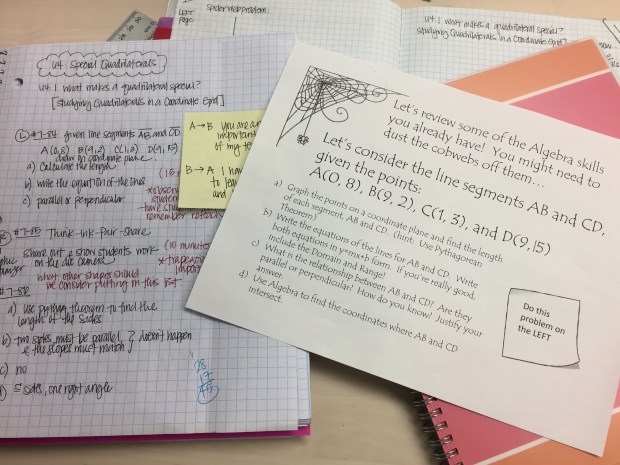
It was a great conversation;  positive and affirming in all the right ways.  He reminded me that success in my classroom means the student that got up in front of the class and explained perfectly how to use Pythagorean Theorem to the class;  success in my classroom means the argument he overheard two students having about the difference between intersecting and perpendicular lines;  success in my classroom means the girl that articulated so eloquently to the class how she figured out the slope of a segment.  And yeah, I didn’t get through the whole lesson but all of THAT happened in 1 class period.

He also reminded me that I teach the low-performing students.  My classes are primarily loaded with students that have traditionally struggled in math so they walk in the door already hating Geometry because it’s a math class.  He reminded me there are a slew of “intentional non-learners” that I am working with.  So, those students that stood up in front of their peers and spoke so beautifully about math are the ones who would have never done that before taking my class.  Those students would have never had arguments about math concepts before taking my class.  My class.  MY class.  I did that.  I facilitated that.  That is success in MY classroom.  It may not be pretty (like students that jump for joy at the idea of writing a proof!) but as they say, “beauty is in the eye of the beholder.”

This was a huge lesson that I needed to learn today because I feel like I fail as a teacher on the daily.  I know I’m my own worse critic and that failures can drive us to be better, but sometimes you just need an affirmation!  Maybe it’s because my definition of success and failure does not fit for my classroom.  In fact, success looks different in every teacher’s classroom.  What seemed so small to me, like a student getting up in front of the class and explaining something, was really a momentous occasion to be celebrated.

As educators, we have to find these successes, celebrate them, and then make them happen again and again.